Every dealership is really two businesses under one roof. Up front, there’s a showroom to sell an experience: polished floors, glass walls, and customers who expect comfort while they browse. In the back, there’s a service bay full of heat, noise, and fumes, where technicians need consistent airflow to do their jobs safely and efficiently. Most dealerships solve these two problems separately, if they solve the showroom side at all. HVLS fans can address both spaces, just not in the same way.
The Showroom: Comfort Without Compromise
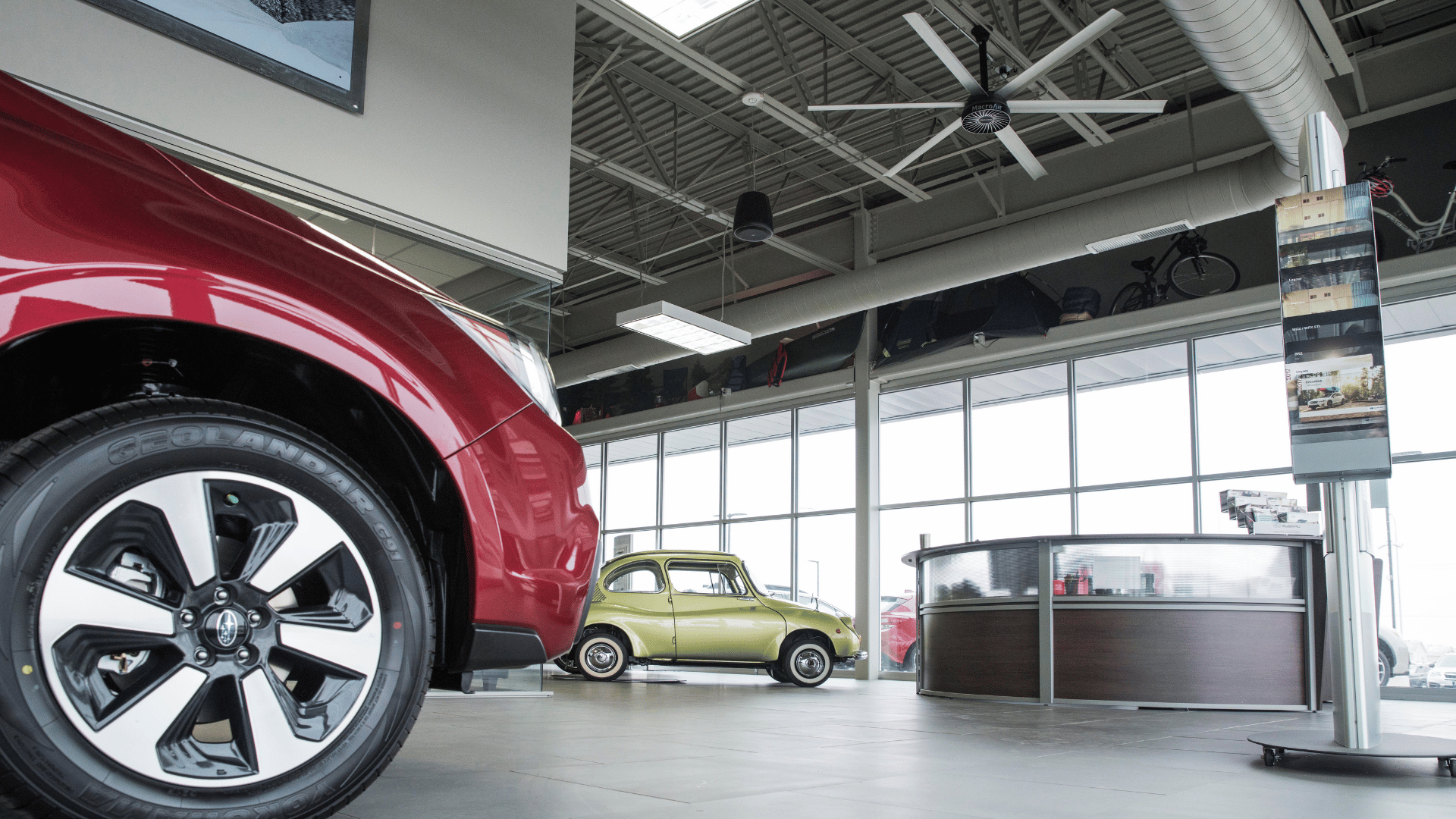
Dealership showrooms present a specific challenge: floor-to-ceiling glass that turns the space into a giant greenhouse. High ceilings that make traditional HVAC work harder than it should, and a customer experience that can’t tolerate loud, distracting noise and equipment. A small home ceiling fan or floor fan is simply not built for a space like this, and the noise alone can undercut the premium feel a showroom is going for.
MacroAir’s direct-drive commercial ceiling fans operate by moving high volumes of air slowly and quietly. We’re talking as quiet as 39-61 decibels, well below the roughly 80 decibels typical of smaller high-velocity fans, while still moving enough air to counteract heat gain from glass walls and high ceilings. The result is subtle, even airflow customers notice as comfort rather than as “a fan running.” These large HVLS fans for dealerships are closer to a modern ceiling fan aesthetic than an industrial one, without sacrificing performance.
The Service Bay: Where the Real Heat Lives
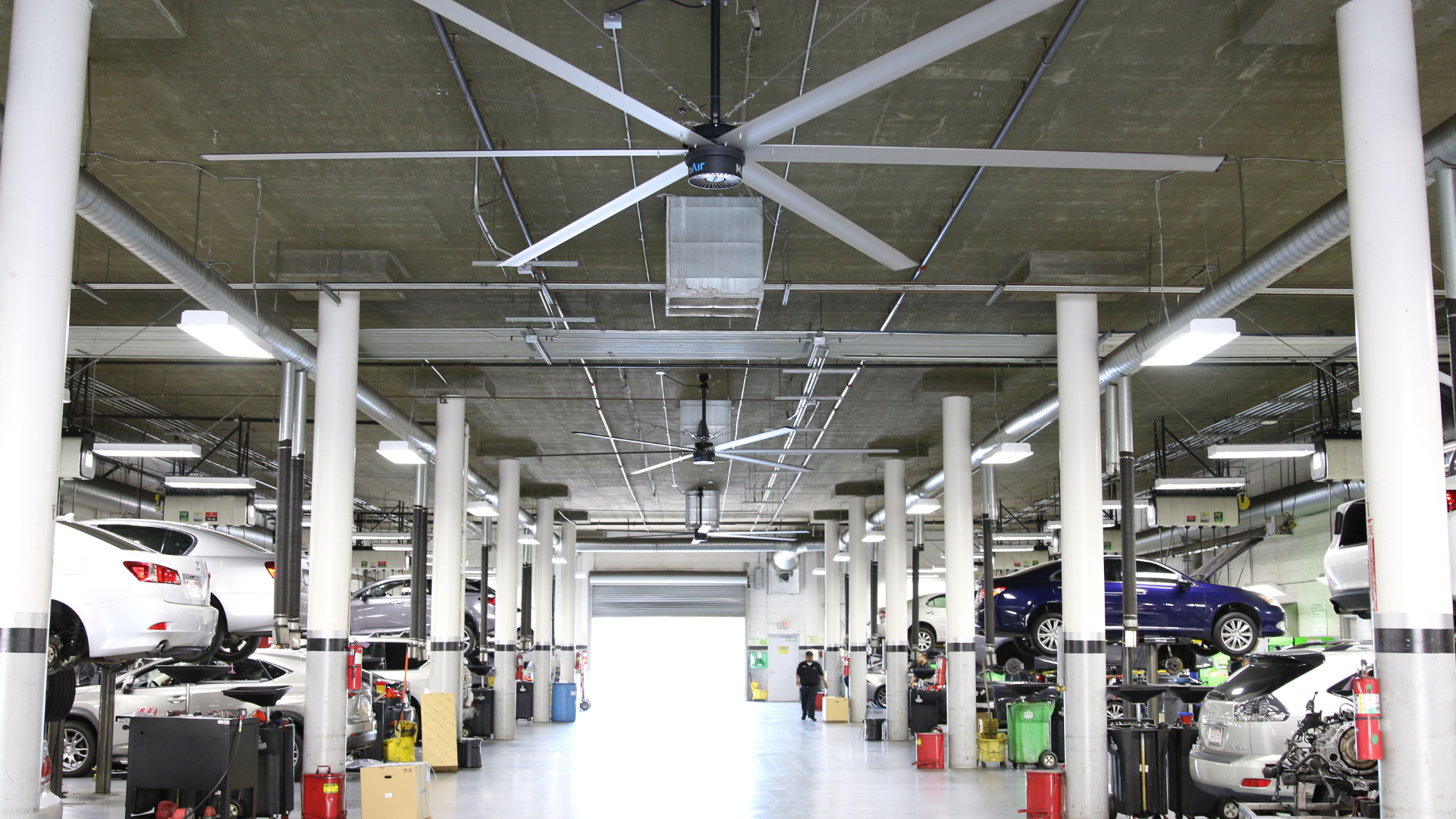
Behind the showroom, the service bay tells a very different story. Garage doors cycle open and closed constantly, exhaust fumes from running vehicles need somewhere to go, and technicians are working hard in an environment where AC struggles to keep it comfortable. Heat exposure in a service bay is a real occupational hazard, not just a comfort issue. The same engineering-control logic we cover in our OSHA Heat Illness Prevention guide applies to service department staff as well.
Crown Lexus in Ontario, California knows this problem well. Before installing MacroAir’s large shop ceiling fans, their body shop felt like “a sauna inside” during peak season. According to their Service Tech Manager, it was hot, humid, and uncomfortable enough to slow employees down and cut into productivity. After installing three HVLS fans, the dealership saw a genuine turnaround: smoother, quieter airflow, a real morale boost, and energy costs that dropped by roughly $400 per month. The full story is covered in our post on the benefits of large shop ceiling fans.
Winter Comfort: Schulte Subaru
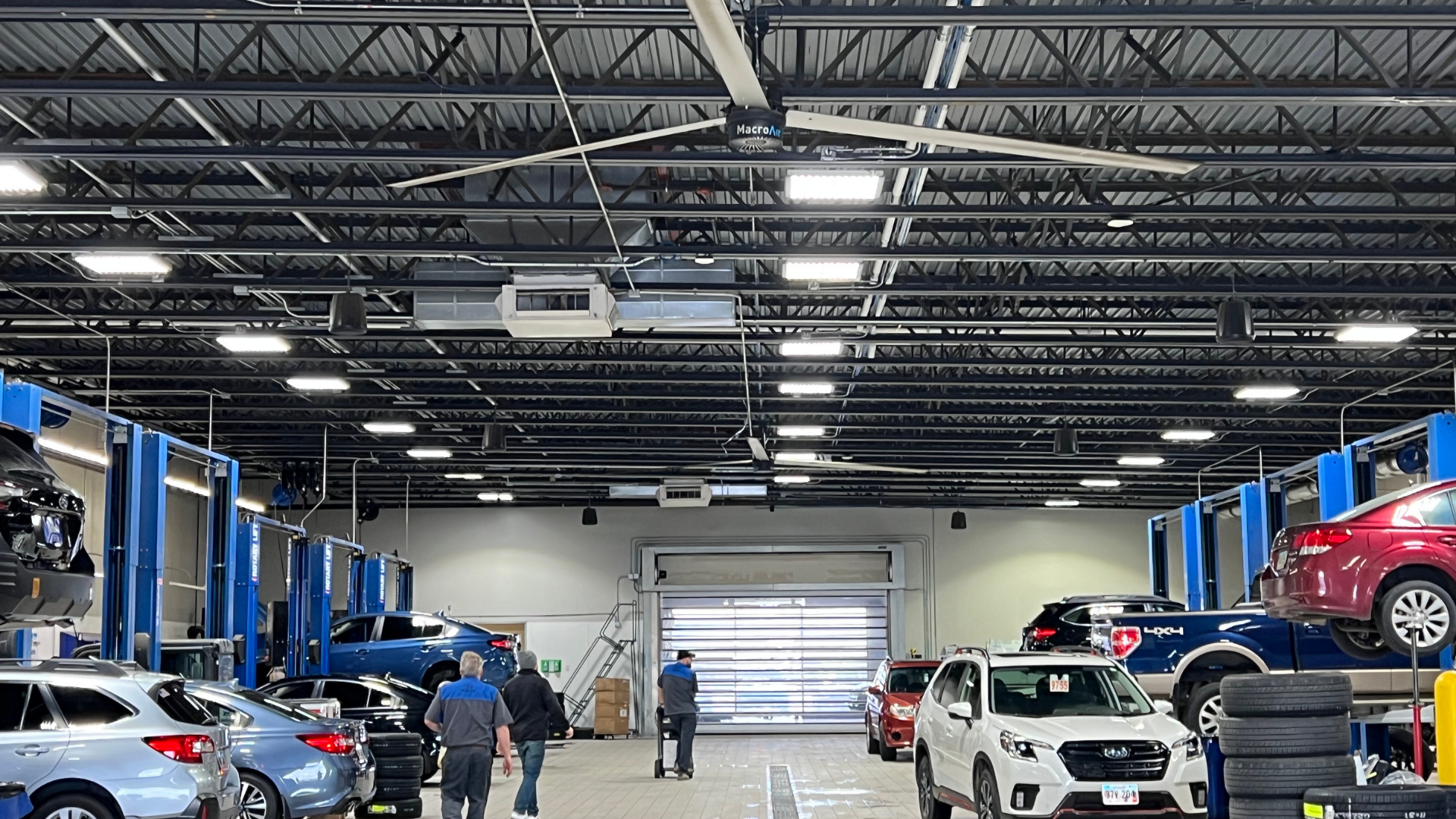
Heat management isn’t only a summer problem. At Schulte Subaru in Sioux Falls, South Dakota, warm air was rising straight to the ceiling during the colder months, leaving the service bays, showroom, and technician areas feeling colder near the ground even with the HVAC system running hard to compensate.
MacroAir installed HVLS fans to help bring that warm air back down to where staff and customers actually are. Run in reverse, HVLS fans work to destratify the air, pulling warm air down from the ceiling rather than letting it collect overhead, which can help even out comfort across a facility and ease some of the load on the heating system. Schulte reported more consistent comfort for employees working in the service bays, a better experience for customers spending time in the showroom and lounge, and some relief on energy costs from reduced strain on their HVAC system. For more on how this works, see our guide to the best ways to heat your warehouse, which covers using HVLS fans in reverse. You can check out Schulte Subaru’s full case study by clicking the button below.
One Manufacturer, Two Solutions
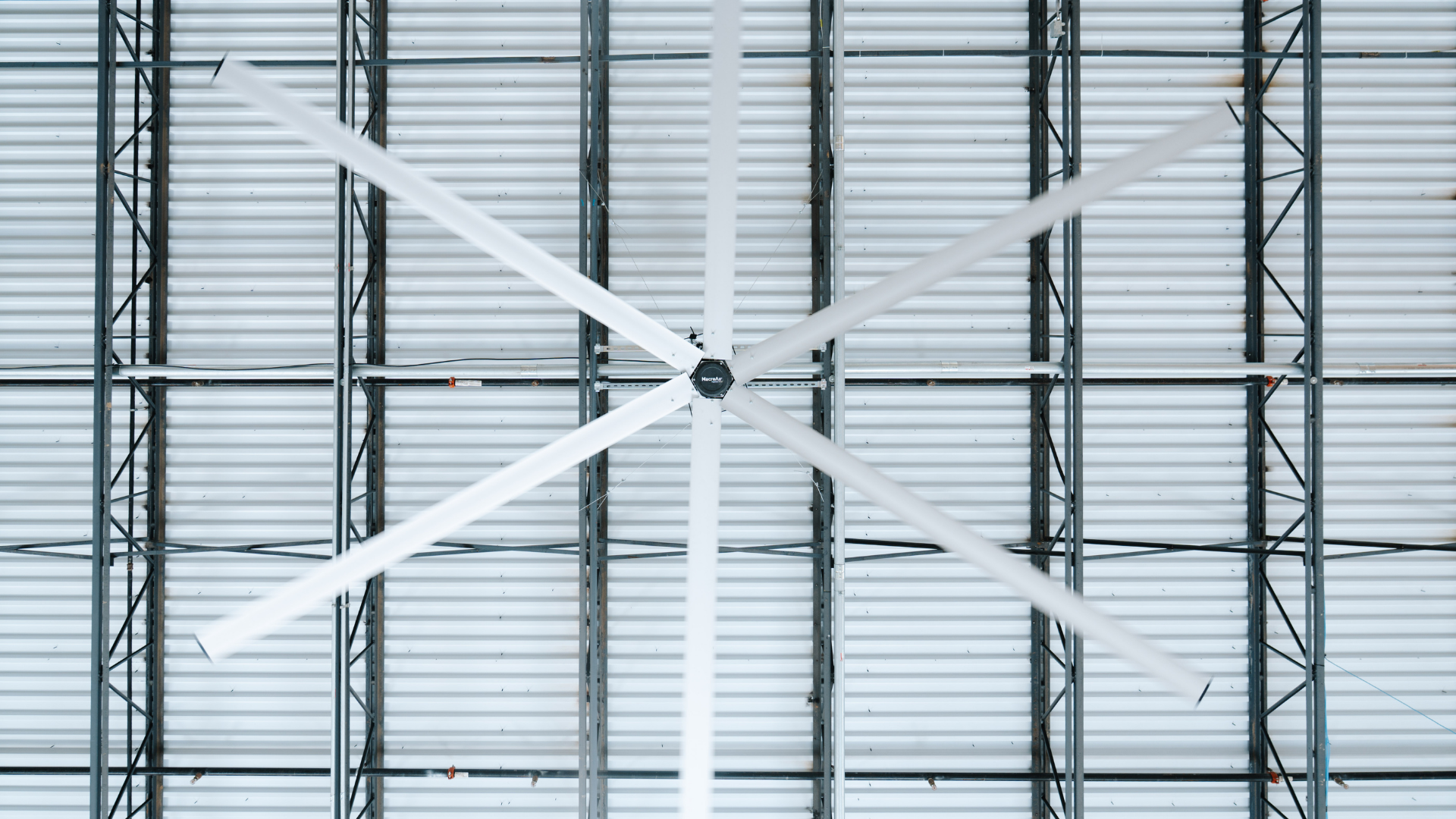
The showroom and the service bay have almost opposite requirements. One prioritizes gentle, quiet, design-forward airflow; the other prioritizes raw airflow and heat management, in both summer and winter. But both are solved by the same underlying HVLS technology, just applied differently. A dealership doesn’t need two separate vendors or two separate strategies. It needs a fan partner who understands both environments and can spec the right ceiling fans for each, and for each season.
That’s also where a facility’s technicians benefit from the same air-quality and ventilation principles covered in our guide to auto body shop ventilation and fume safety. Many dealership service departments handle the same paint, solvent, and exhaust exposure as an independent body shop, and the same engineering-control approach applies. For dealerships looking to keep their service bay organized alongside its airflow upgrade, our mechanic shop organization guide covers the operational side of the same space.
Ready to Upgrade Your Dealership’s Airflow?
Whether you’re looking to improve showroom comfort, support your service technicians, or help manage heating and cooling costs year-round, MacroAir’s HVLS fans are designed for dealerships and repair shops. Explore our automotive solutions to see what may be a good fit for your space.
See HVLS fans for automotive shops
Frequently Asked Questions
Are HVLS fans quiet enough for a customer-facing showroom?
Yes. MacroAir’s direct-drive commercial ceiling fans operate as quietly as 39-61 decibels, significantly quieter than smaller high-speed fans, which can reach around 80 decibels, making them suitable for showroom environments where noise directly affects customer experience.
Can one fan system serve both a dealership showroom and service bay?
The same HVLS technology works in both spaces, but the right model differs. Showrooms benefit from quieter, design-forward direct-drive fans, while service bays typically need large shop fans built for heat, fume dispersal, and heavier-duty use.
How much can dealerships save by installing HVLS fans?
Results vary by facility size and climate, but Crown Lexus saw approximately $400 per month in energy savings after installing three MacroAir fans in their body shop, alongside a measurable productivity and morale improvement.
Can HVLS fans help with heating costs at a dealership in winter?
Run in reverse, HVLS fans can help redistribute warm air that collects near the ceiling back down to floor level, which may ease some of the load on a facility’s heating system. Schulte Subaru saw more consistent comfort and some reduction in energy costs after installing MacroAir fans for this purpose. Results vary by facility and climate.
Do dealership service bays have the same air quality concerns as auto body shops?
Yes. Many dealership service departments perform paint, bodywork, and exhaust-heavy repairs that carry similar fume and ventilation considerations to independent auto body shops, and benefit from the same engineering-control approach.